
About Advent
In the Book of Common Prayer
[T]he Sundays of Advent are always the four Sundays before Christmas Day, whether it occurs on a Sunday or a weekday. (p. 15)
The feast of the Dedication of a Church, and the feast of its patron or title, may be observed on, or be transferred to, a Sunday, except in the seasons of Advent, Lent, and Easter. (p. 16)
In the Book of Worship
Advent is a season of four weeks including four Sundays. Advent derives from the Latin adventus, which means “coming.” The season proclaims the comings of the Christ—whose birth we prepare to celebrate once again, who comes continually in Word and Spirit, and whose return in final victory we anticipate. Each year Advent calls the community of faith to prepare for these comings; historically, the season was marked by fasts for preparation. Each Sunday of Advent has its distinctive theme: Christ’s coming in final victory (First Sunday), John the Baptist (Second and Third Sundays), and the events immediately preceding the birth of Jesus Christ (Fourth Sunday).
In other sources
The Season of Advent is both a time of thanks for the gift of Christ to us in the past and a time for anticipation of Christ’s second coming. It contains both warning and promise. Christmas Day rehearses God’s self-giving in the birth of Jesus Christ.
White, James F.. Introduction to Christian Worship : Fourth Edition Revised and Updated, edited by L. Edward Phillips, Abingdon Press, 2023, p. 62.
So there is always this double sense of adventus – a double sense of the Lord’s coming. The season prepares us for his coming in the graces of the Christmas feast and his coming in judgment at the end of time. The scriptural texts should be expounded with this double sense in mind. In a given text one or the other of these comings may be to the fore, but in fact often the same passage provides us with words and images to ponder on both comings at once.
Homiletic Directory, 2015, para. 79
Theology of the season
Advent as Spiritual Journey
- The old computer game Colossal Cave Adventure was abbreviated as ADVENT. The player explored a cave looking for treasures. One of the first commands a player must give is GET LAMP in order to bring light into the darkness of the cave.
- Journeys must be prepared for:
- Literally, we prepare for hikes with sunscreen, bug spray, shoes, etc.
- Spiritually, the season calls us to be awake, alert and ready along the way.
- Gandalf to Frodo: “It’s a dangerous business, Frodo, going out of your door. You step into the Road, and if you don’t keep your feet, there’s no knowing where you might be swept off to.”
- Journeys require fellowship and bringing friends along is necessary:
- From the opening words of The Legend of Zelda, “It’s dangerous to go alone!”
- For example, the Fellowship of the Ring, the Star Wars rebellion, the Pevensie siblings or the House of Gryffindor.
In other sources
In the Roman empire, the accession of an emperor, accorded divine honours since the time of Augusts (86-14 AD), and the ceremonial entry of a ruler to a province or city, were his ‘advent’ (Latin: adventus: ‘arrival’). The obverse of a gold medallion found at Arras depicts the advent in 296 of Constantius Chlorus at the gates of the city of London. Constantine the Great, his son, was shown on his triumphal arch being welcomed into Rome after his victory at the Milvian Bridge on 29 October 312, a date recorded in the Chronograph of 354 as adventus divi: ‘coming of the deified one’. Latin-speaking Christians, for whom Jesus Christ was the only true Lord and Emperor, borrowed the word and the concept but invested it with a new meaning: ‘the coming of their Saviour’.
Metford, J. C. J. The Christian Year. Crossroad, 1991, p. 29.
A council in Spain in 380 C.E. decreed that “From December 17 until the day of Epiphany which is January 6 no one is permitted to be absent from Church.”25 This is a precedent for the season of Advent at a time when Christmas itself was still unknown in Spain. By the fifth century, a forty-day season of preparation for the Epiphany was being practiced in parts of Gaul. Rome eventually adopted a four-week Advent before Christmas.
White, James F.. Introduction to Christian Worship : Fourth Edition Revised and Updated, edited by L. Edward Phillips, Abingdon Press, 2023, p. 56.
During the following centuries, an anticipatory element appeared in the Ambrosian and Roman rites for the weeks immediately before Christmas. In Gallican ritual, as in the East, Epiphany became a time for baptism, preceded by a forty-day season of preparation. Some churches knew this as “St. Martin’s Lent” since it began near November 11, St. Martin’s Day. The season of Advent resulted from the joining of these two traditions, hence its mixed notes of penitence and joy.
Hatchett, Marion J. Commentary on the American Prayer Book. Seabury Press, 1981, p. 39.
Celebrating the season
No one knows what the Sarum use as to colours was for Advent, Christmas, Epiphany, Lent, Ascensiontide, Whitsuntide, and Trinity Sunday; consequently the so-called Sarum uses are really one-half made up from the fancy of nineteenth-century ritualists.
Dearmer, Percy. The Parson’s Handbook, 1st ed., p. 74.
Late in the middle ages Lent had beome a time of penance for all and Advent a semi-penitential period of preparation for Christ’s coming again as judge.
Hatchett, Marion J. Commentary on the American Prayer Book. Seabury Press, 1981, p. 39.
The tendency at the present day to make another Lent of Advent is quite modern. The O Sapientia in our Calendar may remind us of the spirit of joyful expectation which is the liturgical characteristic of Advent.
Dearmer, Percy. The Parson’s Handbook, 1st ed., p. 203.
The Office Hymns during Advent should be: at Evensong, Creator alme siderum, (Hymnal Noted, 28; H. A. M., 45; People’s Hymnal, 7), and at Mattins, Verbum supernum prodiens, (Hymnal Noted, 29; H. A. M., 46; People’s Hymnal, 8), or En clara vox, (Hymnal Noted, 118; H. A. M., 47; People’s Hymnal, 14).
General
- UMC Book of Worship, The Great Thanksgiving for Advent
- UMC Book of Worship, Worship Resources for Advent, with hymn recommendations and calls to worship
- Prayers of the People from Deacon Ormond Plater Archive
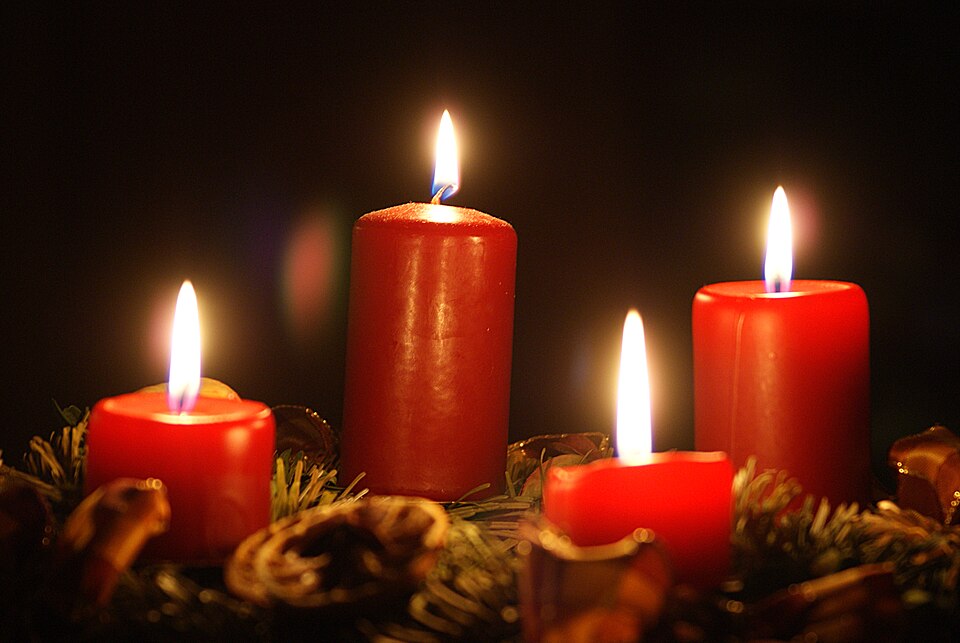
The Advent Wreath
BCP (p. 143, Order of Worship for the Evening): During Advent, the lighting of an Advent Wreath may take place after the Prayer for Light.
BOS (p. 20): The Advent Wreath is a visual symbol marking the progress of the season of Advent, originating as a domestic devotion and an opportunity for family prayer. It functions as a simple countdown-timer for the passage of Advent. Attaching symbolic meaning to particular candles is a more recent innovation. It is important to place the wreath in such a way so that it maintains the centrality of the essential symbols for the assembly: Font, Word, and Table.
When the Advent Wreath is used in the worshiping community at morning services, the appropriate number of candles on the wreath are lighted, without prayer or ceremony, with the other candles. In evening worship, the candle lighting in An Order of Worship for the Evening, described on page 143 of The Book of Common Prayer, is appropriate.
When used in private homes, the Advent Wreath provides a focus for devotions at the time of the evening meal. There are many resources for devotions produced to include the reading of scriptures suitable for the Advent season. The short form of An Order of Worship for the Evening (Book of Common Prayer pages 109–112) is also recommended. In place of the Short Lesson of Scripture provided in the Order, one of the readings from the Daily Office Lectionary may
be used, in whole or in part.
Advent Lessons and Carols
- TEC Book of Occasional Services 2022, p. 22
- UMC Book of Worship: An Advent Service of Lessons and Carols
Las Posadas
- TEC Book of Occasional Services 2022, p. 27
- UMC Book of Worship: Las Posadas (A Services of Shelter for the Holy Family)
Sundays and Holy Days
- The First Sunday of Advent
- The Second Sunday of Advent
- The Third Sunday of Advent
- The Fourth Sunday of Advent
- Saint Andrew the Apostle, November 30
- Saint Thomas the Apostle, December 21